

You slide into the pew a few minutes late. Your mind is still in the car, replaying a hard conversation, a bill that came due, or a worry about someone you love. The music begins, everyone stands, and you wonder how to pray when your heart feels scattered. If that sounds familiar, you are in good company. This guide gathers catholic mass prayers in one place so you can prepare before Mass, follow along with confidence during it, and carry its grace home afterward.
You will find original prayers you can say in your own words, clear explanations of the prayers the whole congregation prays together, Scripture connections for each part of the liturgy, and honest answers to the questions people often ask.
Random Wishes Generator
✨ Random Wishes Generator
Tap the button to get a beautiful wish, then copy it in one click.
Click “Generate Wish” to see your wish here 🎁
What Prayers Are Said at a Catholic Mass?
The main prayers and responses at Mass are the Sign of the Cross, the Penitential Act (including the Confiteor), the Gloria, the responses to the readings, the Nicene Creed, the Prayers of the Faithful, the “Holy, Holy, Holy” (Sanctus), the Our Father, the Lamb of God, and the words said just before Communion, “Lord, I am not worthy.” The priest also prays the Collect, the Eucharistic Prayer, and the blessing, while the people answer with “Amen” and other short responses.
Some parishes sing parts of these prayers. Others speak them. Either way, they all belong to the same conversation between God and his people.
Why the Mass Is the Church’s Greatest Prayer
The Catechism of the Catholic Church (CCC 1324) calls the Eucharist the “source and summit” of the Christian life. That is a big claim, and it explains why Catholics treat the Mass as more than a service to attend. It is the place where the Church does what Jesus asked at the Last Supper: “Do this in memory of me” (Luke 22:19).
Traditionally, Catholic prayer falls into four kinds, and the Mass holds every one of them:
- Adoration: praising God for who he is, as in the Gloria and the Sanctus.
- Contrition: asking forgiveness, as in the Penitential Act and the Lamb of God.
- Petition: asking for what we and others need, as in the Prayers of the Faithful.
- Thanksgiving: gratitude for what God has done, which reaches its height in the word Eucharist itself, which means “thanksgiving.”
Jesus promised, “Where two or three are gathered in my name, there am I in the midst of them” (Matthew 18:20). At Mass you are never praying alone, even if you are the only one in your row who feels unsure of the words.
Prayers Before Mass
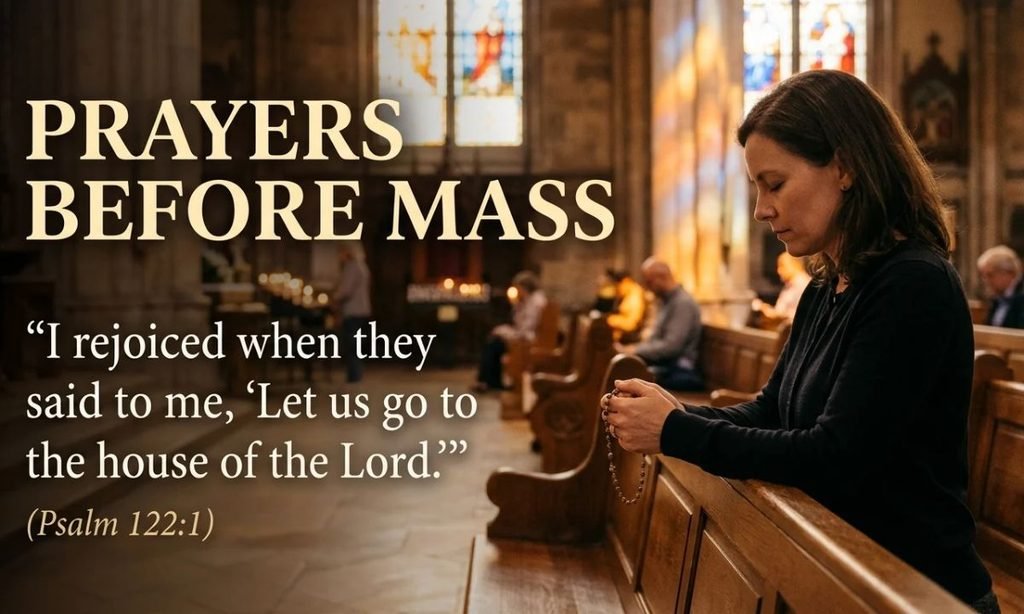
The few minutes before Mass begins are a gift. Arriving early, even by five minutes, gives your heart time to settle. You do not need a perfect prayer. You only need to turn toward God.
A Short Prayer When You Enter the Church
“I rejoiced when they said to me, ‘Let us go to the house of the Lord.'” (Psalm 122:1)
Lord Jesus, I am here. I have walked in carrying my week with me: the tiredness, the unfinished work, the people I am worried about. I set it all down at your feet. Meet me in this hour the way you met the disciples at the table. Open my eyes to recognize you. Amen.
A Prayer for a Distracted Mind
Every Catholic struggles with distraction. Do not be discouraged by it. Offer the distraction itself to God.
Father, my thoughts keep running ahead of me. Quiet them, please. Where I cannot focus, let my presence be my prayer. Where I wander, gently bring me back to the altar, the Word, and the face of your Son. I want to be here with my whole heart, so help me with the part I cannot do. Amen.
A Prayer to Prepare Your Heart for Communion
The great saints, including Thomas Aquinas and Ambrose, left beautiful longer prayers for the moments before Communion, and they are well worth finding in a Catholic prayer book. Here is a simpler one in everyday language.
Lord, you are about to come to me in the Eucharist, and I do not deserve it. Yet you invite me anyway. Clear away whatever stands between us: pride, bitterness, old resentments, the sins I have not yet named. Make room in me for your peace. Let me receive you with reverence, with gratitude, and with a heart that wants to change. Amen.
If you are aware of serious sin, the Church encourages you to go to Confession first. The sacrament of Reconciliation is the ordinary way to be ready for Communion again.
A Prayer to Your Guardian Angel
Holy angel of God, you stand before the Father’s face and guard me by his command. Stay close to me in this Mass. Lift my prayers with yours, protect my mind from distraction, and help me welcome my Lord. Amen.
Offering Your Intentions
Many Catholics quietly name their intentions as Mass begins. You might pray:
God of mercy, I place on the altar the people and needs I carry today. You know their names and their burdens better than I do. Unite them to the sacrifice of Christ, and answer in the way that is best. Amen.
As you pray these catholic mass prayers before the liturgy starts, remember that you are joining a prayer that began long before you arrived and will continue after you leave.
Prayers During Mass, Step by Step
The Mass has two main parts, the Liturgy of the Word and the Liturgy of the Eucharist, framed by the Introductory Rites at the start and the Concluding Rites at the end. The Catechism says these parts form “one single act of worship” (CCC 1346). Here is what you will pray in each, and what it means.For the Church’s official guidance on each part of the liturgy, see the General Instruction of the Roman Missal from the U.S. Conference of Catholic Bishops.
| Part of Mass | Key prayers and responses | What you are doing |
| Introductory Rites | Sign of the Cross, Penitential Act, Gloria | Gathering, repenting, praising |
| Liturgy of the Word | Responsorial Psalm, Creed, Prayers of the Faithful | Listening, believing, interceding |
| Liturgy of the Eucharist | Holy, Holy, Holy; Our Father; Lamb of God | Offering, giving thanks, receiving |
| Concluding Rites | Blessing and Dismissal | Being sent into the world |
The Introductory Rites
Mass begins with the Sign of the Cross, the same gesture Catholics use to begin and end nearly every prayer. When the priest greets the people with “The Lord be with you,” you answer, “And with your spirit.” That exchange is a mutual blessing.
Next comes the Penitential Act. Whether you pray the Confiteor (“I confess to almighty God…”) or the shorter forms, this is a moment of honesty. You admit that you have sinned in thought, word, and deed and ask for mercy. The “Lord, have mercy” that follows echoes the cry of the blind man in the Gospels, who would not stop calling out to Jesus.
On most Sundays outside Advent and Lent the assembly then prays or sings the Gloria, an ancient hymn of praise that begins with the song of the angels at Bethlehem. It is joy breaking out after repentance.
A prayer you can add silently:
Lord, I come as I am, with real sins and real hopes. Forgive what I cannot fix and strengthen what you are already healing. Let my praise be honest and my sorrow sincere. Amen.
The Liturgy of the Word
Here the Church opens the Scriptures. After the first reading, you respond with the Psalm. After the second, you hear the Gospel acclamation, which in most seasons is “Alleluia” (during Lent, a different phrase is used). Before the Gospel, you answer “Glory to you, O Lord.” Afterward you say, “Praise to you, Lord Jesus Christ.”
The homily follows, then the Nicene Creed on Sundays and solemnities. The Creed is the faith of the whole Church, first shaped by councils in the fourth century when the divinity of Christ was being debated. Praying it together reminds you that your belief rests on something larger than your own feelings on a given morning.
Then come the Prayers of the Faithful, in which the whole community prays for the Church, the world, those in need, and the dead. After each intention, the people usually respond, “Lord, hear our prayer.” Paul urged this kind of prayer: “I urge that supplications, prayers, intercessions, and thanksgivings be made for all people” (1 Timothy 2:1).
A prayer to pray with the readings:
Speak, Lord, and give me ears to hear. Let one line of today’s Scripture stay with me through the week. Where your Word comforts me, let me rest in it. Where it challenges me, give me the courage to obey. Amen.
The Liturgy of the Eucharist
The gifts of bread and wine are brought to the altar, and the priest invites the people to pray that the sacrifice may be acceptable to God. You answer with a response that asks the Lord to accept the sacrifice “for the praise and glory of his name, for our good, and for the good of all his holy Church.”
The Preface dialogue (“Lift up your hearts” and “We lift them up to the Lord”) leads into the Sanctus, “Holy, Holy, Holy Lord God of hosts.” It joins your voice to the angels’ song from Isaiah 6:3. During the Eucharistic Prayer, the priest speaks the words of Christ over the bread and wine, and the Church proclaims the Mystery of Faith.
The Eucharistic Prayer ends with the Great Amen. That single word is your “yes” to everything that has just taken place. Sing it, or say it, with conviction.
Then the whole congregation prays the Our Father, the prayer Jesus himself taught. After the Sign of Peace, the Lamb of God (“Agnus Dei”) is prayed or sung while the priest breaks the host. It draws on John’s words, “Behold, the Lamb of God, who takes away the sin of the world!” (John 1:29).
Just before Communion, the priest holds up the host and the people respond with words rooted in the centurion’s faith in Matthew 8:8, humbly asking Christ to “only say the word” and heal the soul. It is one of the most beautiful acts of humility in the liturgy.
A prayer you can whisper as Communion approaches:
Lord Jesus, I am unworthy, and I am so grateful. You come not because I have earned you but because you love me. Say the word, and heal what is wounded in me. Amen.
The Concluding Rites
The priest blesses the people, and the deacon or priest dismisses them with words such as “Go in peace, glorifying the Lord by your life.” The people answer, “Thanks be to God.” The word “Mass” itself comes from this sending forth. You are not leaving a service. You are being commissioned.
What to Pray When You Receive Communion
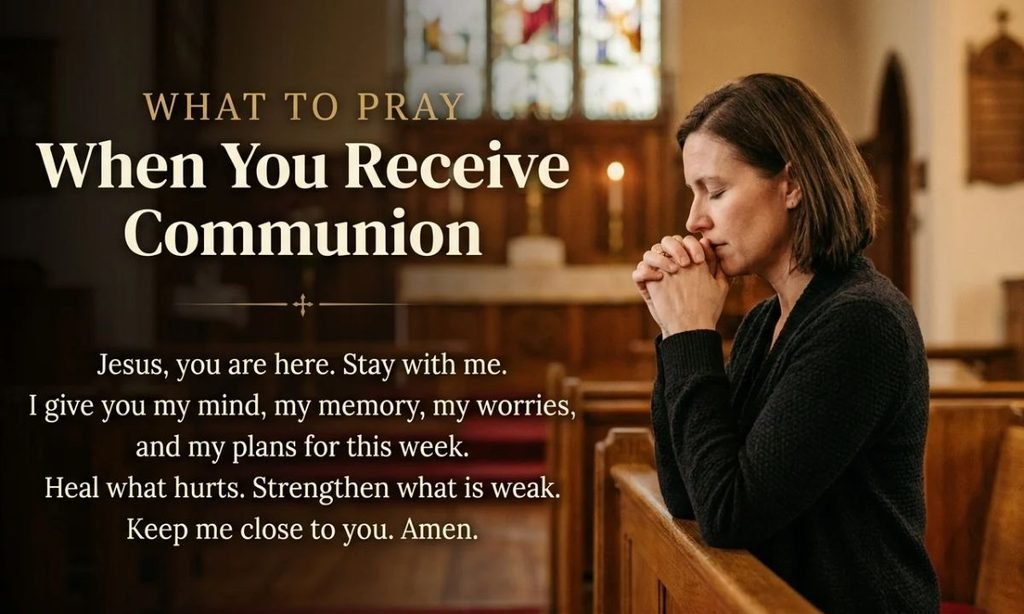
Many Catholics wonder what to say in the moments of Communion itself. The minister says, “The Body of Christ,” and you answer, “Amen.” That Amen means “I believe, and I receive.” Afterward, return to your pew and spend the quiet time that follows with Jesus.
Jesus, you are here. Stay with me. I give you my mind, my memory, my worries, and my plans for this week. Heal what hurts. Strengthen what is weak. Keep me close to you. Amen.
A Prayer of Spiritual Communion
Some people at Mass cannot receive Communion: non-Catholics, children who have not yet made First Communion, Catholics preparing for Confession, or those who are homebound and unable to attend. The Church encourages a prayer of spiritual communion, an act of desire to be united to Christ.
My Jesus, I believe that you are truly present in the Blessed Sacrament. I love you above all things, and I long to receive you into my soul. Since I cannot receive you sacramentally now, come at least spiritually into my heart. I embrace you as if you had already come, and I unite myself wholly to you. Never let me be separated from you. Amen.
Prayers After Mass
The last hymn is ending and people are gathering their coats. Try staying in the pew for just two minutes. Gratitude after Mass keeps its grace from slipping away.
A Prayer of Thanksgiving
“What shall I render to the Lord for all his bounty to me?” (Psalm 116:12)
Thank you, Father, for gathering me here. Thank you for your Word, for your Body and Blood, and for the patience with which you keep calling me back. I cannot repay you, but I can give you my yes. Take what I have and use it. Amen.
A Prayer to Carry the Mass Into the Week
Lord, send me out the way you sent the disciples after the breaking of the bread. Let me be kind in small things: at my desk, at my kitchen table, in traffic. Let your peace go ahead of me into every room I enter. Make my life a thank-you. Amen.
A Prayer for Protection and Forgiveness
The Gospel never lets us forget that following Christ includes loving difficult people. Jesus said, “Love your enemies and pray for those who persecute you” (Matthew 5:44). Psalm 91:11 also reminds us that God “will command his angels” to guard us on our way.
Lord, protect me from harm of every kind, and guard my heart from bitterness. For the people who have hurt me, I ask your mercy, not revenge. Soften what is hard in them and in me. Where I cannot forgive on my own, forgive through me. Keep me under your care today and always. Amen.
A Short Memorized Prayer: The Anima Christi
The Anima Christi (“Soul of Christ”) is a medieval prayer many Catholics learn by heart and pray quietly after Communion. Its simple lines ask Christ to sanctify, save, strengthen, and keep us. If you are looking for one prayer to memorize, it is a lovely place to start.
Prayers to Offer at Mass for Special Needs

The Mass is also the great prayer of intercession. Offering your needs while you are united to Christ’s sacrifice is one of the most meaningful ways a Catholic prays.
For the Sick and Suffering
James 5:14-15 speaks of the “prayer of faith” that raises the sick. You can bring someone’s name to the altar:
Divine Physician, I bring you the one I love who is ill. Be near them in pain and in fear. Give the doctors wisdom and the family endurance. If it is your will, restore them to health; and in all things, let them know they are not forgotten. Amen.
For the Dead
Catholics have prayed for the faithful departed since the earliest centuries. A Mass can be offered for a particular person.
Merciful Father, remember your servant who has died. Forgive whatever needed forgiveness, and bring them into the light of your face. Comfort those who grieve, and give us the hope that death does not have the last word. Amen.
For Family and Friends
Lord, watch over my family. Heal the quarrels, soften the silences, and teach us to love one another as you have loved us. Let our home be a place where your name is spoken with gladness. Amen.
If someone you love is expecting, these prayers for pregnancy pair Scripture with prayers for every stage, from the first positive test to delivery day.
For Peace in a Troubled Time
God of peace, our world is weary of conflict. Move the hearts of leaders, protect the vulnerable, and make me a person who brings calm instead of fuel to the fire. Let your peace begin with me. Amen.
For Strength When You Are Weary
“My grace is sufficient for you” (2 Corinthians 12:9).
Father, I am tired in ways sleep cannot fix. Meet me in this Mass. Feed me with your Word and your Body, and give me strength for the next step, only the next one. I trust that you are enough. Amen.
Bible Verses That Light Up the Mass
Much of the Mass is Scripture, either quoted directly or echoed. These verses can deepen how you pray it.
- Psalm 34:8: “Taste and see that the Lord is good.” An invitation to experience God, not only think about him.
- John 6:35: “I am the bread of life.” Jesus’ own words about the nourishment he offers.
- Luke 22:19: “Do this in memory of me.” The command that stands behind every Mass.
- 1 Corinthians 11:26: As often as you eat this bread and drink the cup, you proclaim the Lord’s death until he comes.
- Luke 24:35: The disciples knew Jesus “in the breaking of the bread.”
- Isaiah 6:3: The seraphim’s cry of “Holy, holy, holy,” which becomes our Sanctus.
- Psalm 141:2: Prayer rising like incense, reflected in the way the Church offers worship.
- Matthew 28:20: “I am with you always,” the promise carried into the Concluding Rites.
- Hebrews 10:24-25: A reminder not to neglect meeting together, but to encourage one another.
- Romans 12:1: The call to offer our lives as a living sacrifice, which the Mass makes concrete.
Simple Ways to Pray the Mass With Your Whole Heart

- Arrive early. Even five minutes of silence changes how you hear the readings.
- Read the Sunday readings ahead of time. The Word lands differently when it is familiar.
- Use a missal or the pew card. Following the printed text helps when your mind drifts.
- Sing, even badly. Song is prayer, not performance.
- Mind the Eucharistic fast. Catholics abstain from food and drink, except water and medicine, for one hour before receiving Communion.
- Stay a little afterward. Give thanks in silence before you go.
Conclusion
The Mass is not a performance to get right. It is a meeting. God speaks in his Word, gives himself in the Eucharist, and sends you back into your ordinary life changed in small ways you may not notice at first. Whether you pray from a book, from memory, or in a few plain words from your own heart, you are joining prayers that have been lifted up by believers for centuries.
So come early, bring your burdens, and expect to be met. Pray the responses even when they feel routine. Stay a moment after the final blessing. Over time, these prayers will shape the way you think, forgive, and love. The same Lord who fed the disciples in Emmaus is still present in the breaking of the bread, and he is glad you are there.
Frequently Asked Questions
What do you say at a Catholic Mass?
The congregation joins in the Sign of the Cross, the Penitential Act, the Gloria (outside Advent and Lent), the responses to the readings, the Creed, the Prayers of the Faithful, the Sanctus, the Our Father, the Lamb of God, the Communion response, and the final “Thanks be to God.” Most parishes provide a missal or card in the pews.
Have the Mass responses changed?
Yes. In 2011, the United States adopted the third edition of the Roman Missal, which brought the English wording closer to the original Latin. The most familiar change is “And with your spirit.”
What is the most important prayer of the Mass?
The Eucharistic Prayer, prayed by the priest, is the heart of the Mass because it is the prayer in which bread and wine become the Body and Blood of Christ. The people share in it through their attentive presence, their “Amen,” and their sung or spoken acclamations.
What should I pray while waiting in line for Communion?
Any short, honest prayer will do. Many people repeat, “Lord, I believe; help my unbelief,” or silently say the words of the centurion. The goal is simply to be aware of who you are about to receive.
Can a non-Catholic pray along at Mass?
Yes. Visitors are welcome to join the prayers, stand, sit, and kneel as they feel comfortable. Communion is normally reserved for Catholics, though many parishes invite non-Catholics to come forward for a blessing, usually with arms crossed over the chest. Practices vary, so it is fine to ask the pastor.
What if my mind wanders during Mass?
Everyone’s does. Gently bring your attention back, without scolding yourself. A distracted prayer offered sincerely is still a prayer, and God honors the effort to return.
Do I have to memorize the prayers?
No. Most people learn them by repetition over time. In the meantime, follow the missal or pew card and let the words become familiar.
